
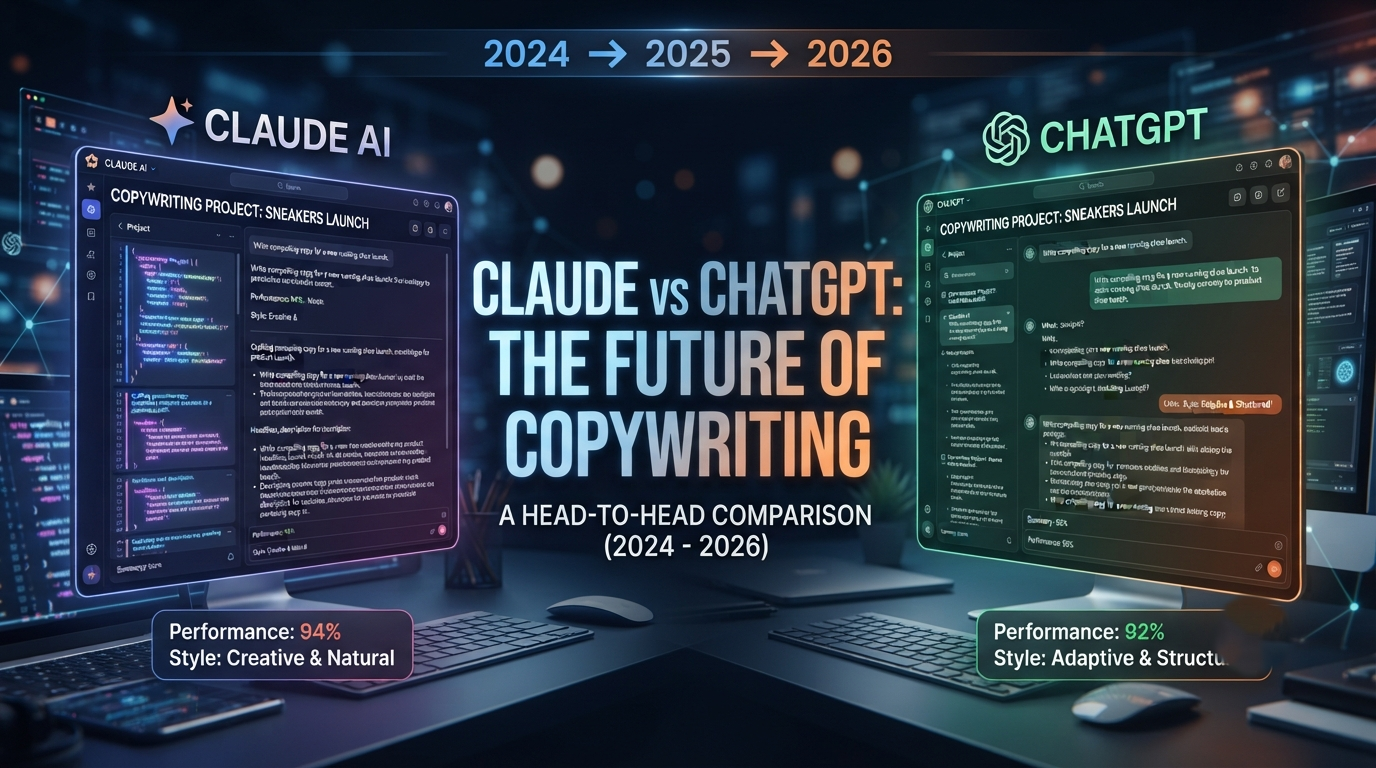
Digital marketing moves fast, and the tools copywriters rely on are changing just as quickly. If you’ve been trying to figure out whether Claude or ChatGPT is the better fit for your work right now and where things are headed by 2026 you’re asking the right question. Both are genuinely impressive. But they’re not the same, and the difference matters more than most people realize.
A Close Look at Claude vs ChatGPT for Copywriting 2024: Key Features and Innovations
Innovation in Language Processing
The debate here really comes down to what kind of writing you’re trying to do. Claude has a noticeably strong grasp of tone and context it tends to “read the room” better when you need copy that feels emotionally tuned to a specific audience. That empathetic quality shows up most clearly in brand storytelling and long-form work where voice consistency really counts.
ChatGPT, on the other hand, brings a wide-ranging knowledge base and a kind of chameleonic flexibility. It can shift between styles quickly, which makes it a solid workhorse for teams juggling a lot of different content types at once.
Key Features Defined
One thing worth noting about Claude is how well it holds a thread across long pieces. Thematic consistency isn’t something every AI handles gracefully, but Claude does it better than most. If you’re writing a 2,000-word campaign narrative or a detailed product story, that matters.
ChatGPT’s edge is speed and creative variety. It’s particularly good at generating a burst of ideas or nailing a conversational register useful when you’re building out chatbot scripts, interactive content, or social copy that needs to feel spontaneous. As both tools keep developing, the gap between them is narrowing, but each still has its own clear lane.
Comparing Claude vs ChatGPT for Copywriting 2026: What Has Changed?
Evolution in Language Processing Capabilities
By 2026, both tools have taken meaningful steps forward. Claude’s latest version handles complex sentence structures with noticeably more sophistication the kind of nuance that makes a difference when you’re writing for a discerning B2B audience or crafting copy where precision is non-negotiable.
ChatGPT has gone deep on conversational quality. Its 2026 iteration feels more natural in interactive formats less like a robot trying to sound casual, more like someone who actually gets how people talk. The focus on making every exchange feel personalized and genuine is a real improvement over where it was even a year ago.
Adaptations in Content Personalization
Here’s where things get genuinely interesting. Both platforms have rolled out smarter personalization features, but they’re approaching it differently. Claude leans on audience data analysis it’s gotten good at tailoring content to specific segments in ways that lift engagement rather than just hitting the right demographic checkboxes.
ChatGPT’s approach is more reactive. It integrates real-time feedback loops to adjust content as it goes, which keeps things timely and relevant. For brands operating in fast-moving spaces where yesterday’s message is already stale, that responsiveness is a genuine asset.
Both approaches work. Which one fits better just depends on whether you’re playing a longer strategic game or need to stay agile in the moment.
How to Choose Between Claude and ChatGPT for Your 2024 and 2026 Copywriting Needs
Assess Your Copywriting Objectives
Start by getting clear on what you actually need the tool to do. Factual, research-heavy content? Creative storytelling? Hard-sell persuasion? Claude tends to shine in the narrative and creative space, while ChatGPT’s versatility makes it a natural fit for teams who need one tool to handle a wide mix of formats. Neither is universally better it really comes down to the work.
Evaluate Performance and Features
Look at language fluency, how well each tool understands context in your specific niche, and how intuitive the interface is for your workflow. ChatGPT’s recent updates have pushed its contextual coherence forward in a meaningful way. Claude’s strengths in voice and tone consistency haven’t gone anywhere either. If you’re thinking ahead to 2026, keep an eye on the roadmap for both the feature gap is shifting, and what’s true today may look different in eighteen months.
Budget and Resource Allocation
Cost matters too, obviously. Subscription structures differ between the two platforms, and some of the more advanced features sit behind higher pricing tiers. The honest move is to map out what you’d actually use day-to-day and see which platform delivers real value at a price that makes sense for your operation not just which one looks better on paper.
FAQs
What are the main differences between Claude and ChatGPT in copywriting?
The core difference comes down to design philosophy. Claude is built around nuanced language understanding it’s particularly good at producing copy that feels genuinely human in its creativity and emotional register, which makes it a strong choice for intricate or emotive work. ChatGPT’s strength is range. It generates diverse content styles quickly and handles tonal shifts well, making it a flexible pick for teams with varied copywriting demands.
Is one better suited for long-form content than the other?
For long-form, Claude has a real advantage. It maintains coherence and depth across extended pieces in a way that holds up well you’re less likely to notice it drifting off-topic or losing the thread halfway through. ChatGPT is faster and more adaptable, which makes it excellent for short-form work where speed and variation matter more than sustained depth.
How do they handle SEO and keywords?
Both are capable here. That said, ChatGPT’s larger training dataset gives it a slight edge when it comes to recognizing trending keywords and working them into copy naturally. If SEO performance is a primary concern, that’s worth factoring in though Claude is by no means weak in this area.
Related Post

ZonAPK Free Fire Emotes Download: Complete Guide to Getting All Emotes